

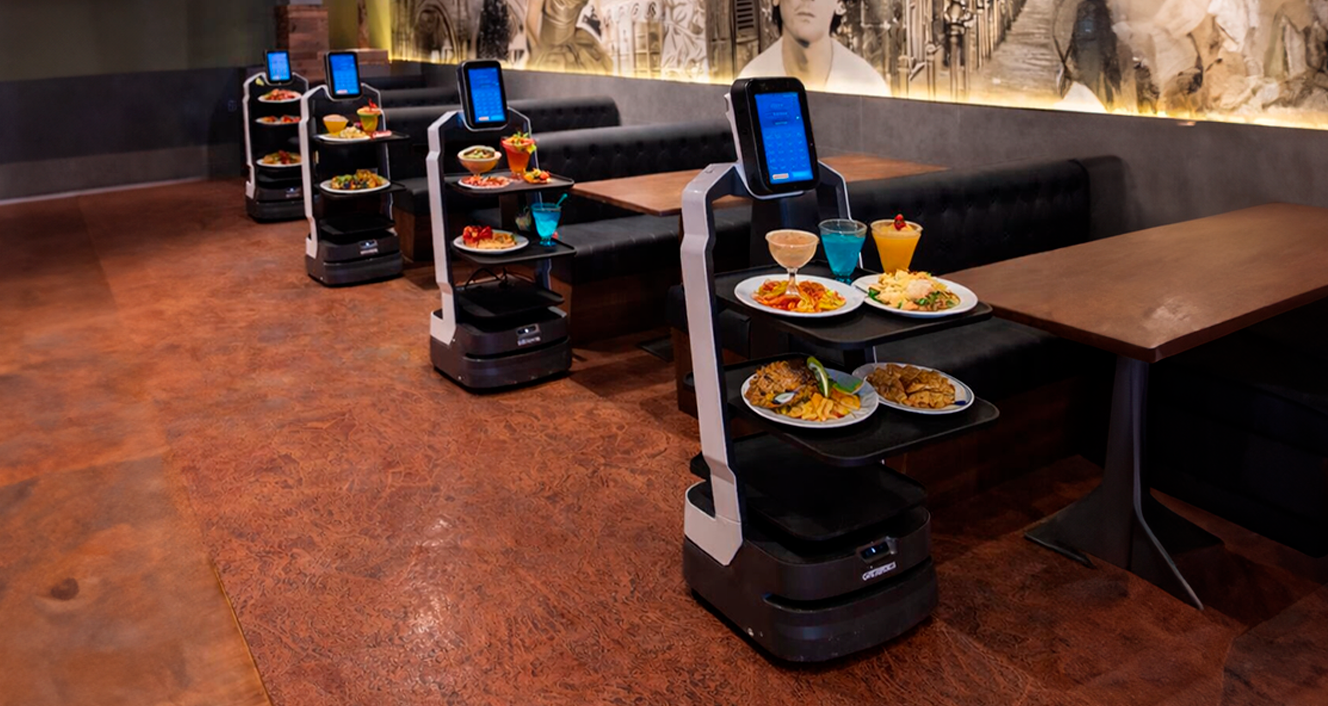
Autoserve Multi-Robotic: the restaurant model already operating in the United States and shaping the future of LATAM
In Elkridge, Maryland, just a few minutes from Washington, DC, we launched a new operating architecture for restaurants. This is not a venue that simply adds robots, but a service model designed from the ground up to integrate automation, technology, and customer experience into a single coherent system.
This project was implemented at Viva Chicken Italian Restaurant (Viva Ristorante), located at 7600 Hearthside Way, Suite 500, Elkridge, MD 21075, where four CarryX lite robots are already operating as a structural part of daily service.
What is Autoserve Multi-Robotic?
Autoserve Multi-Robotic is a restaurant architecture in which the customer self-serves from their table, the order is taken fully digitally, and a fleet of robots coordinates delivery, while the human team focuses exclusively on the kitchen, operational control, and the customer experience.
It is not partial automation. It is a complete system where technology, robots, and the service flow are integrated from the restaurant’s design.
How does it work in practice?
From the moment the customer enters the restaurant, the Autoserve system is activated. Upon entering the venue, they are welcomed by a digital panel stating:
“Welcome, please choose an available table. At the table you will find a QR code to place your order.”
After sitting at a table, the customer scans the QR code placed on it and, from their own phone, places the order directly—without intermediaries—with full clarity on the menu, timing, and available options. This speeds up service and reduces friction from the first interaction.
Meanwhile, in the kitchen, the team prepares the dishes and places them on the robot’s trays, telling the robots which tables they must go to.
The robots move autonomously throughout the restaurant and, upon arriving at the corresponding table, they play a message:
“Your order is on tray 2.” The tray lights up, the customer takes their food, and sends the robot back.
This process repeats continuously—without friction, without waiting, and without relying on waiters.
The power of the multi-robot system
Our client operates with four robots working simultaneously, where each one knows in real time its own position, the position of the others, active routes, and pending destinations. Thanks to this cloud coordination, the entire fleet functions as a single intelligent system capable of deciding which robot departs first, preventing blockages, distributing workload, and maintaining a constant operational flow.
In this venue, the system is mapped for 62 tables, but it can be adapted to more or fewer depending on the size of the restaurant.
In addition, each robot can serve up to three tables in a single run, allowing large orders or multiple tables to be handled in parallel.
Why is this model so attractive? Although the implementation took place in the United States, the Autoserve Multi Robotic model is especially attractive for other markets because it addresses real challenges such as high staff turnover, rising labor costs, hard-to-manage demand peaks, and increasingly digital customers—by enabling more tables to be served with the same team, reducing wait times, standardizing the experience, and preparing the restaurant to scale, all without sacrificing the kitchen or the gastronomic concept.
More than delivery, a platform for experience
The robots don’t just deliver dishes; they can also display on-screen advertising, announce promotions, support celebrations, show digital menus, and collect used plates—becoming an active point of communication and operations within the restaurant.
The restaurant stops being just a place to consume and becomes a technological platform for service and physical marketing.
For Viva Ristorante, this model is not an isolated pilot but the foundation of a new restaurant format designed to be replicated across other locations and cities, where the next step is to optimize routes, activate more features, integrate surveys and promotions, add cleaning and security robots, and open new restaurants under the same operating scheme.
For operators in the region, Autoserve Multi Robotic is not a future promise but a model already operating in the United States with real customers, real orders, and real peak hours—and for restaurant groups in other markets it represents a concrete opportunity to differentiate, modernize, scale, protect margins, and attract an increasingly digital customer.
Here is a video showing how it works:
If you want to learn how to implement Autoserve Multi-Robotic in your restaurant or chain, or if you would like to review our portfolio of robotic solutions, email us at info@zoxrobotics.com